Fintech · Corporate Travel
Field employees pay for business trips out of pocket, then wait weeks to get it back. TravelWallet fixes this with three mechanisms, not one, each matched to how predictable an expense actually is.
— The Thesis
Existing tools pick one mechanism for every expense. A hotel booking, a daily meal allowance, and a vehicle breakdown have nothing in common, except that one app tries to handle all three the same way.
I benchmarked logistics and pharma, industries that solved field-expense problems for the field years before software tried to. None of them use one wallet. They split by predictability.
That became the thesis.
— The Model
Every expense category sits somewhere on a predictability line. The mechanism it gets is a direct function of where it sits, not a default applied to everything.
Auto-credited to the employee's wallet the moment a trip starts. No request, no approval loop. Receipts required only above ₹500. Unused balance returns automatically at trip end. Non-transferable.
In plain terms: like a daily allowance that just shows up.
Known before the trip, variable in amount. Employee requests a category, amount, and context. Finance approves the exact figure. The wallet is category-locked, so it cannot be spent anywhere else.
In plain terms: ask for money before you spend it.
Camera opens first. The amount field stays locked until a bill photo is uploaded, non-negotiable. On approval, funds move to the employee's bank account within 24 hours.
In plain terms: snap the bill, then enter the amount.
— The Guardrail
"Receipts must be uploaded within 24 hours" is a sentence in an onboarding PDF nobody reads. A greyed-out amount field is a sentence nobody can ignore.
Most expense tools enforce receipt rules as written policy, a clause employees agree to once and forget. Compliance depends on memory and goodwill.
For Emergency Claims, the camera is the first screen. The amount input is physically disabled until a bill photo exists, so the employee cannot submit a number before proof.
— Designed Against
Unused balances, per diem or advance, auto-return to the company wallet 24 hours after trip end. Per diem can't be cashed out or transferred to another account.
This wasn't about distrust. It was about making the wallet behave like a tool, not a slush fund. Every rupee that goes out has a category, an expiry, and a return path.
— The Outcome
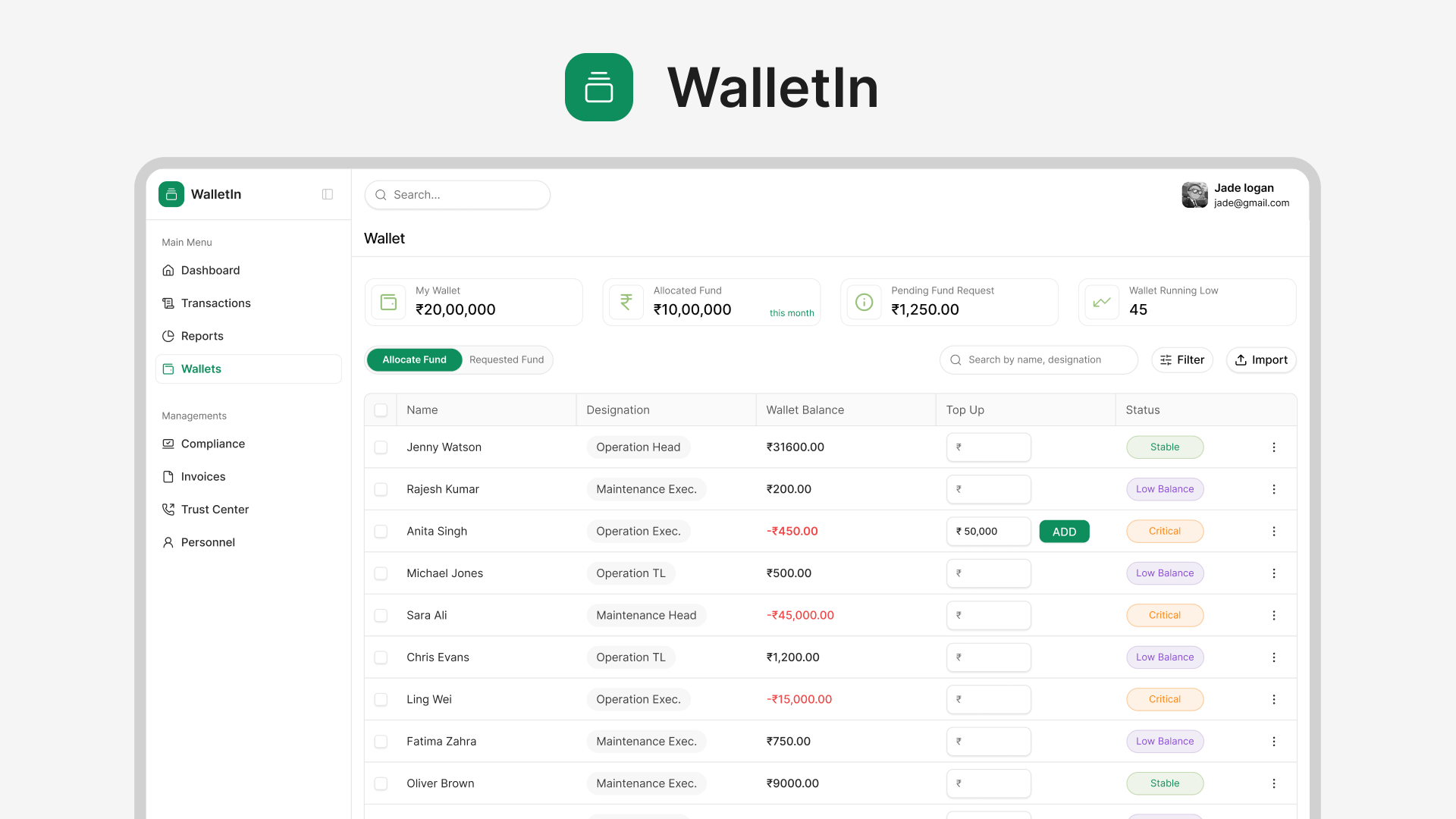
Finance gets an inline approve/reject queue with no email digging. Emergency claims surface in red, flagged Urgent, with the bill thumbnail visible before the click.
For the employee: per diem lands automatically, advances load the moment they're approved, and emergency reimbursements move to their bank account in under 24 hours, a window that used to be measured in weeks.